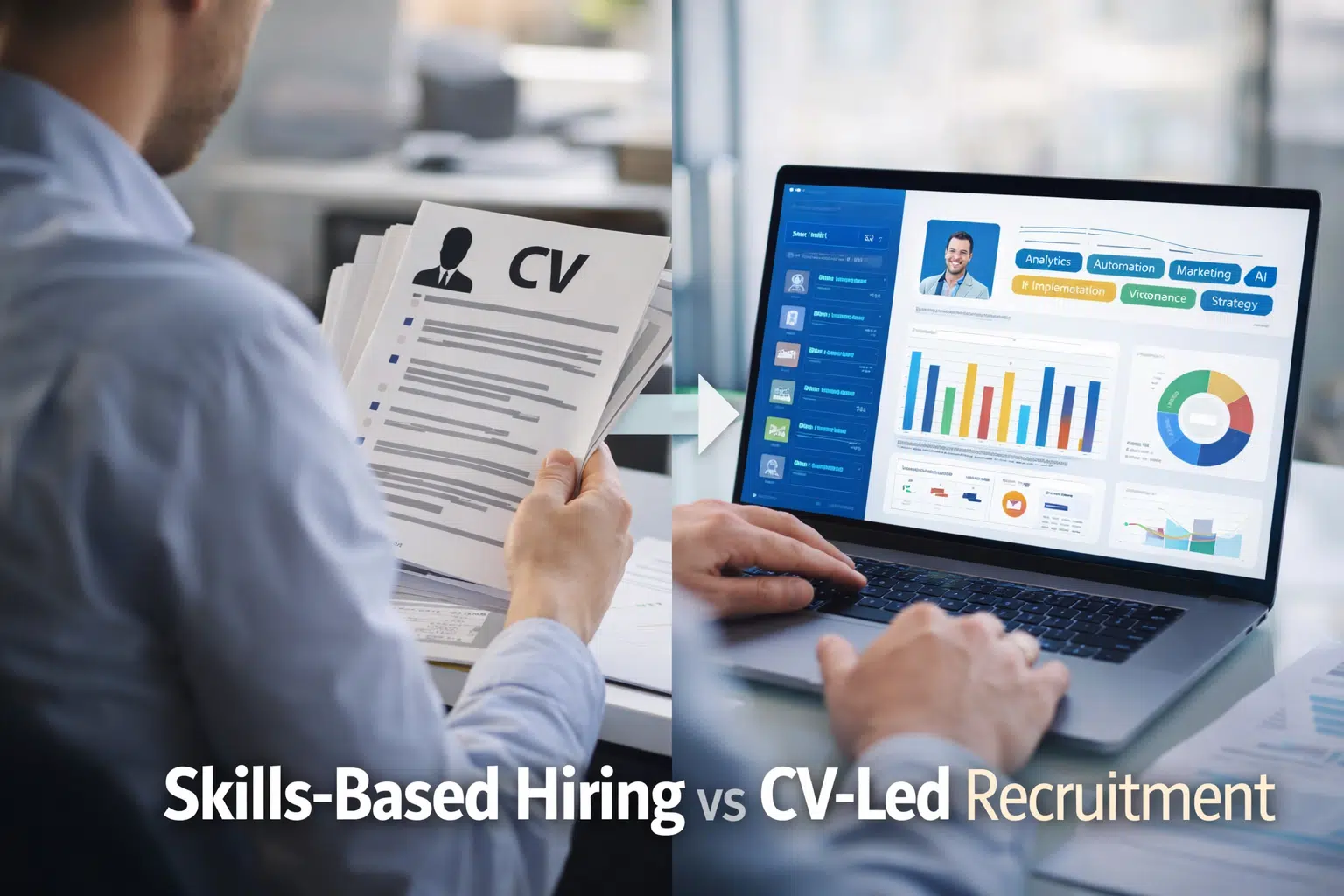
Why Skills-Based Hiring Beats CV-Led Recruitment in 2026
The hiring landscape in 2026 looks very different to even a few years ago. Roles are evolving faster, technology is reshaping job requirements, and business priorities are increasingly commercial and outcome-driven.
Yet many organisations are still relying on one traditional screening tool: the CV.
While CVs provide useful background information, they don’t always tell you what really matters whether a candidate can deliver impact in your business today. That’s why forward-thinking organisations are shifting toward skills-based hiring.
Here’s why it’s outperforming CV-led recruitment in 2026.
1. Job Titles No Longer Tell the Full Story
In a fast-changing market, job titles are inconsistent and often misleading.
A “Growth Manager” in one organisation might focus heavily on analytics and automation, while in another the role is primarily partnerships-led. A “Project Manager” might be operational in one business and transformation-focused in another.
Screening candidates purely by job title risks overlooking high-potential individuals whose experience doesn’t neatly align on paper, but whose skills are exactly what your business needs.
Skills-based hiring shifts the focus from where someone has worked to what they can do.
2. Roles Are Evolving Faster Than CVs
Technology adoption particularly AI and automation is accelerating change across industries.
Many professionals are developing high-value capabilities outside of their formal job descriptions. They’re implementing AI tools, automating reporting processes, improving workflows, or driving commercial initiatives that never make it onto a structured CV in detail.
A CV often reflects history.
Skills reflect capability.
In 2026, capability is what drives performance.
3. It Expands Your Talent Pool
One of the biggest advantages of skills-based hiring is access to broader talent.
When organisations screen strictly by industry background, specific company names, or linear career paths, they unintentionally narrow their options.
By focusing on core competencies such as commercial decision-making, stakeholder management, AI implementation, or revenue generation, businesses can identify transferable talent from adjacent sectors.
This is particularly valuable in competitive markets where specialist experience is limited but adjacent skill sets are abundant.
4. It Reduces Bias and Improves Diversity
CV-led recruitment can introduce unconscious bias.
Factors such as university background, employer brand names, career gaps, or non-linear progression can influence shortlisting decisions, even when they’re not directly relevant to performance.
A skills-first approach helps standardise evaluation around measurable capabilities and outcomes.
When hiring decisions are grounded in demonstrable impact and competency, organisations often see stronger diversity outcomes and more balanced talent pipelines.
5. Performance Is Linked to Impact, Not Tenure
In uncertain economic conditions, hiring decisions carry greater risk. Businesses are investing in individuals who can deliver measurable value.
Skills-based hiring allows you to assess candidates against outcomes:
- Have they driven revenue growth?
- Have they implemented cost-saving automation?
- Have they improved operational efficiency?
- Have they led successful transformation projects?
Tenure alone doesn’t guarantee performance. Demonstrated skill and impact do.
6. It Aligns with Hybrid Skill Demands
In 2026, some of the most valuable professionals are hybrid operators, individuals who combine technical expertise with commercial awareness.
For example:
- A finance professional who automates reporting and improves forecasting accuracy
- A software engineer who understands customer impact and product strategy
- A marketer who can independently analyse and optimise campaign performance
- An operations leader fluent in digital transformation tools
These hybrid capabilities rarely show up clearly in job titles alone. A skills-based assessment helps uncover the true depth of a candidate’s contribution.
7. It Supports Long-Term Workforce Planning
Hiring for skills rather than static job descriptions enables greater organisational agility.
As business priorities shift, whether through expansion, digital transformation, or market changes, adaptable, skill-rich employees are better positioned to evolve with the company.
Skills-based hiring doesn’t just fill today’s vacancy. It strengthens tomorrow’s workforce resilience.
What Skills-Based Hiring Looks Like in Practice
Adopting a skills-first approach doesn’t mean ignoring CVs entirely. Instead, it means reframing how you assess them.
Leading organisations in 2026 are:
- Defining roles by capability and outcomes rather than rigid job histories
- Assessing measurable achievements over responsibilities
- Using competency-based interviews to evaluate impact
- Prioritising transferable skills where appropriate
- Aligning hiring decisions with commercial objectives
The shift is subtle, but powerful.
The Bottom Line
In today’s market, hiring the right person is about identifying impact potential, not just reviewing career history.
CVs show experience.
Skills show value.
Organisations that prioritise capability over chronology are building stronger, more adaptable teams and gaining a competitive advantage in the process.
Rethinking Your Hiring Strategy?
If you’re looking to refine your recruitment approach or explore how a skills-based strategy could strengthen your hiring outcomes, our team can help.
We work closely with clients to define high-impact role requirements, identify transferable talent, and deliver candidates who align with both capability and commercial goals.
Let’s build teams around skills not just CVs.